
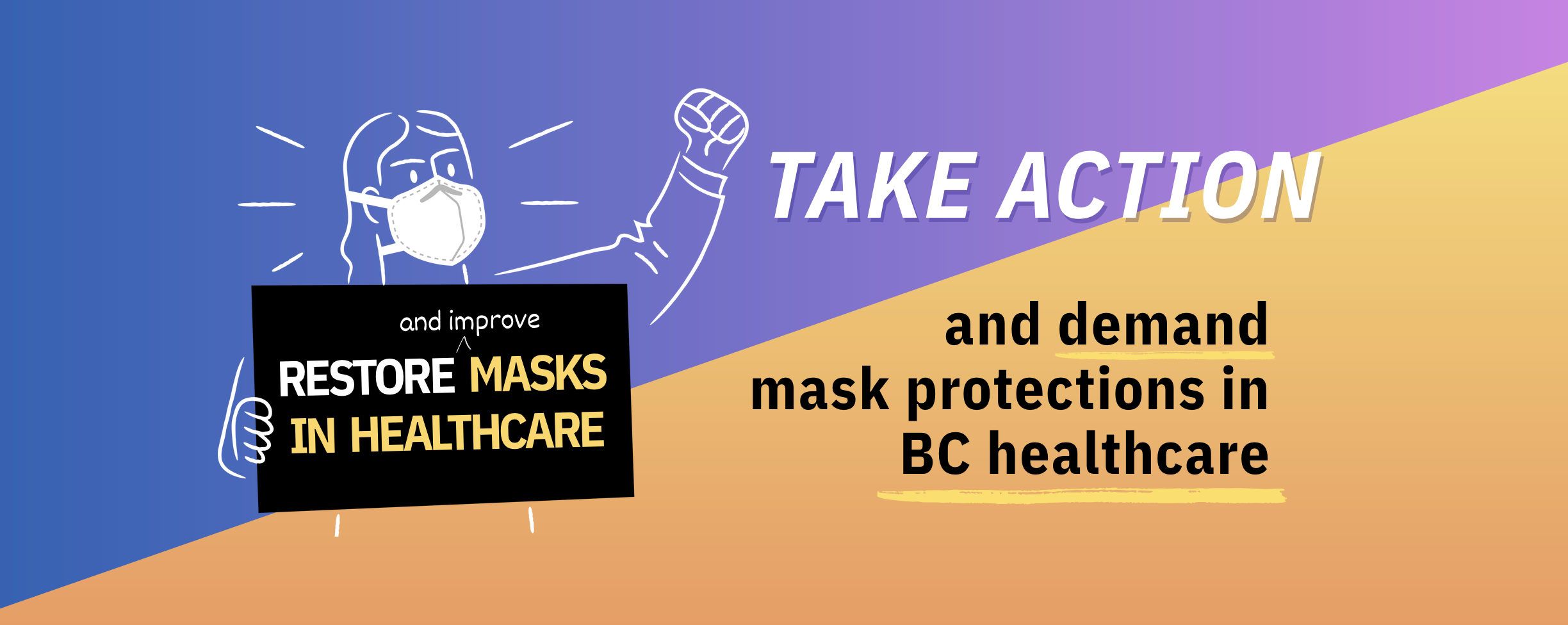
Demand mask protections in BC healthcare now.
How to use: This form lets you email your MLA plus dozens of BC healthcare officials at once. Enter your address to help find your local representative, then scroll past the list of recipients, review, and send.
If you have capacity, we encourage you to personalize the email for greater effectiveness. Even just changing the subject line and adding a sentence at the beginning can help!
Note: the “Action Network” tool requires a return address so their system can find your MLA. If you prefer not to enter your address, you can use our template wording to email policy-makers yourself.
Following repeated healthcare outbreaks of airborne and respiratory-transmitted illnesses and multiple ER closures throughout the summer, a new COVID-19 wave is picking up in North America. As of September 15, BC has the highest COVID rates in Canada by far, while other illnesses like measles continue to circulate, and influenza is already causing new outbreaks in healthcare.
It’s past time for BC to protect patients and healthcare workers by reinstating a mask mandate in healthcare settings.
N95 masks can be up to 100% effective in reducing healthcare worker infections. They can also help prevent prolonged (and costly) patient infections: for example, COVID hospitalizations for Omicron in BC have cost an estimated $2.6 billion and rising. This past fall, Newfoundland, Labrador, PEI, and major Quebec and Ontario hospitals all restored masks to healthcare settings, while facilities in some jurisdictions are already doing so again.
BC needs to catch up, and act on calls from doctors, patients, major unions, BC’s Human Rights Commissioner, and multiple national and international health organizations for improved mask requirements in healthcare settings.
We demand BC take urgent action to protect patients, healthcare workers, and our healthcare system:
- Restore healthcare mask requirements in BC and maintain them year-round. Prevention should be proactive, not reactive, especially as illnesses like COVID-19, measles, RSV, and flu can all spread without obvious symptoms.
- Make respirators (like N95 masks) the default choice in healthcare, as the only masks rated to properly protect against airborne illnesses. This move has been widely supported by over 1,700 experts, advocates, and major unions like the Canadian Labour Congress and Canadian Federation of Nurses Unions. It’s also very cost-effective, due to the wide availability of surplus N95 stock (not to mention, prevention of expensive prolonged hospitalizations).
- Close gaps in prior rules by requiring patients to mask (with reasonable exceptions); ensuring mask coverage in shared locations like hallways and waiting rooms, rather than leaving this open to interpretation; clearly communicating the federal and international scientific consensus that COVID-19 is an airborne illness; and directing privately-run healthcare settings to meet the same minimum mask requirements as government-run facilities.
- Provide clear direction to all health authorities on concrete steps to enact mask requirements to ensure more consistent implementation. This includes requiring hospital admin to direct managers on implementation; posting signage; making masks available; and designating staff members responsible for informing and monitoring staff, visitors, and patients.
Other ways to take action:

1. Flood the phone lines
One of the most effective ways to reach policy makers! Use our phone script to make it easier – and if phone conversations are challenging, you can leave messages instead!

2. Send letters to the editor
Reply to any media stories about “respiratory illness season”, healthcare shortages, or outbreaks in BC. Even a few sentences helps, and you can pull wording from this page.

3. Meet your MLA
Request a meeting with your MLA (can be via phone or Zoom). Use our quick facts, or share stories from British Columbians.

4. Send faxes online
Use our downloadable template letter to send faxes online – no machine required. It’s like an email they can’t delete!

5. Send postcards
Send our printable #Postcards4PublicHealth, or use any old card you have on hand. Mail to MLAs and Ministers is free!

6. Hold authorities accountable
Fill out feedback surveys, attend health authority board meetings (dates on their websites), and report unsafe workplaces.
More on why this matters
- Patient safety: Gaps in infection control put patients in greater, even life-threatening danger. Evidence shows that during an outbreak, 39% of air samples in a hospital contained COVID-19, and past studies indicate that hospital-acquired COVID-19 is at least 70 times more deadly than COVID contracted in the community. Shockingly, up to 63.2% of hospitalized COVID patients in Canada are infected in the hospital itself. Meanwhile, the rise of measles in Canada, the incoming flu season, and a surge in avian influenza outbreaks and measles exposures all highlight the ongoing risks from other airborne illnesses.
- Worker protection: Healthcare workers face the highest rates of workplace COVID claims, while just a single case of H5N1 in BC potentially exposed 60 healthcare workers. BC’s commitment to recruiting healthcare workers needs to include protecting the workers we already have, as well. This includes upgrading from surgical masks to respirators (like N95s), since CDC / NIOSH states that “[surgical masks] do not provide a reliable level of protection from aerosolized particles because of the loose fit…Surgical masks are not respiratory protective devices”.
- Healthcare efficiency and cost reduction: In a challenging economic environment, protecting and strengthening core services like healthcare is crucial. Omicron COVID hospitalizations alone in BC have cost an estimated $2.6 billion and rising, and medical costs rise each fiscal year. Studies show staff masking leads to 33% fewer hospital-onset respiratory viral infections, which could significantly lower these costs. Preventing healthcare-acquired infections can help reduce surgery delays and longer, far costlier hospitalizations. It’s also crucial to reduce staff shortages caused by acute or long-term illness, which can contribute to increased ER closures.
- Preventing long-term health and economic impacts: Canada’s Office of the Chief Science Advisor emphasizes that preventing COVID infection is also key to preventing Long COVID: a disabling long-term condition that is not only life-altering for many COVID survivors and loved ones, but which causes massive costs for health systems and economies. As of 2023, 1 in 9 Canadians had Long COVID, and adults with two or more COVID infections were 76% more likely to receive a new health diagnosis. The provinces are already struggling with federal health transfers that will be inadequate to cover costs related to inflation and an aging population, so minimizing preventable health costs should be a priority. This in turn reduces economic impacts: one study has found that nearly half of people with Long COVID cannot work, and Long COVID is projected to cost OECD member countries (including Canada) $135 billion US per year in economic losses over the next ten years, not including medical costs.
- Accessibility and health equity: Multiple polls show 85–91% of respondents delay healthcare due to lack of safety measures. British Columbians have sent tens of thousands of messages so far calling for masks in healthcare – a particularly pressing need for Indigenous, racialized, disabled, 2SLBTQIA+ and lower-income community members, all of whom continue to face disproportionate harm from illnesses like COVID-19. And of course there are many people whose health status makes them vulnerable. Lack of mitigations such as mask mandates put them in the very difficult position of risking further illness, disability or even death when accessing health care.
- A necessary layer: Hand hygiene does not address transmission through the air. Since many illnesses can spread before symptoms, symptom-based risk assessments alone are insufficient. While vaccination is vital, it doesn’t fully prevent COVID infections or long-term health impacts; offers less protection for many immunocompromised people (and is not possible for newborns); and is no longer required for BC healthcare workers. Masks are a low-cost, high–impact safety tool that should be used alongside these other measures to help close the gaps.
- An evidence-based solution: Studies show resumption of staff masking is associated with a 33% decrease in hospital-onset respiratory viral infections, while N95 masks reduce exhaled viral load by 98%. Upgrading to N95 masks in COVID wards can reduce healthcare worker infections by up to 100%. A study on SARS-CoV-1 co-authored by BC’s current Provincial Health Officer similarly found that “Consistently wearing a mask…was protective for the nurses”, and that “[r]isk was lower with consistent use of a N95 mask than with consistent use of a surgical mask.”
- Year-round risks: In contrast to BC’s messaging about “respiratory illness season”, NACI states that “seasonality of SARS-CoV-2 has not been established” – while other illnesses like measles and tuberculosis can also cause issues throughout the year. This is why mask protections are necessary in healthcare year round – after all, if there’s a setting where you can always expect to find sick people, it’s in healthcare!
“If there is one space that all vulnerable people should be able to rely on to prioritize their safety, it is in healthcare settings…removal of universal masking directives in healthcare settings does not uphold a human rights centred approach to public health.”
Past versions
Looking for our late spring 2025 campaign to keep and improve healthcare mask requirements? Find it here.
Looking for our spring 2025 campaign to keep and improve healthcare mask requirements? Find it here.

Looking for our fall/winter 2024 campaign to restore healthcare mask requirements? Find it here.

Looking for the second wave of our Vulnerability Isn’t Seasonal campaign? Find it here.

Looking for the first version of first ‘Vulnerability Isn’t Seasonal’ campaign? Find it here.

About Us
We’re a non-partisan action group of British Columbians advocating for evidence-based safety measures in high-risk settings.